UAE VAT
UAE VAT, in plain words.
The parts that actually trip businesses up — and how Fisqel keeps each of them right as you trade, instead of at the deadline.
Last reviewed September 2026
- Standard rate
- 5%On most goods and services since 1 January 2018.
- Must register
- AED 375,000Taxable supplies and imports in the last 12 months, or expected in the next 30 days.
- May register
- AED 187,500Voluntary registration once supplies or expenses pass this figure.
- To file and pay
- 28 daysAfter each tax period ends, through EmaraTax.
Standard-rated, zero-rated or exempt?
No VAT is charged on zero-rated or exempt supplies — but they behave very differently for you. Zero-rated supplies still go on your return and let you recover the VAT on your costs. Exempt supplies generally don't.
Standard-rated · 5%
- Most goods and services sold in the UAE
- Commercial rent
- Restaurants and hotels
- Professional services to UAE clients
Zero-rated · 0%
- Exports of goods outside the GCC implementing states
- Many services to non-residents
- International transport
- Qualifying healthcare and education
Exempt
- Residential rent and resale
- Bare land
- Local passenger transport
- Certain financial services
Fisqel classifies each line when it's recorded, and flags anything genuinely ambiguous for you rather than guessing.
What a tax invoice must show
Issue it within 14 days of the supply. A simplified tax invoice is allowed where the customer isn't VAT-registered or the supply is AED 10,000 or less.
Every Fisqel tax invoice includes these fields automatically.
- 01The words “Tax Invoice”
- 02Your name, address and TRN
- 03Your customer's name, address and TRN, if they're registered
- 04A sequential invoice number
- 05The date of issue, and the date of supply if different
- 06Description, quantity and unit price for each line
- 07The VAT rate and amount for each line
- 08The total payable, in AED
- 09The exchange rate, if the invoice is in another currency
- 10A note where the reverse charge applies
Filing, and what lateness costs
The FTA sets your tax period — quarterly for most businesses, monthly for some. The return and the payment are both due within 28 days of the period ending.
- Late return
- AED 1,000 the first time; AED 2,000 if repeated within 24 months.
- Late payment
- 14% a year on the unpaid tax, calculated monthly, for defaults from 14 April 2026.
- Records
- Keep your invoices, receipts and records for at least five years.
Fisqel shows your next deadline and the amount due on the dashboard, and reminds you on WhatsApp.
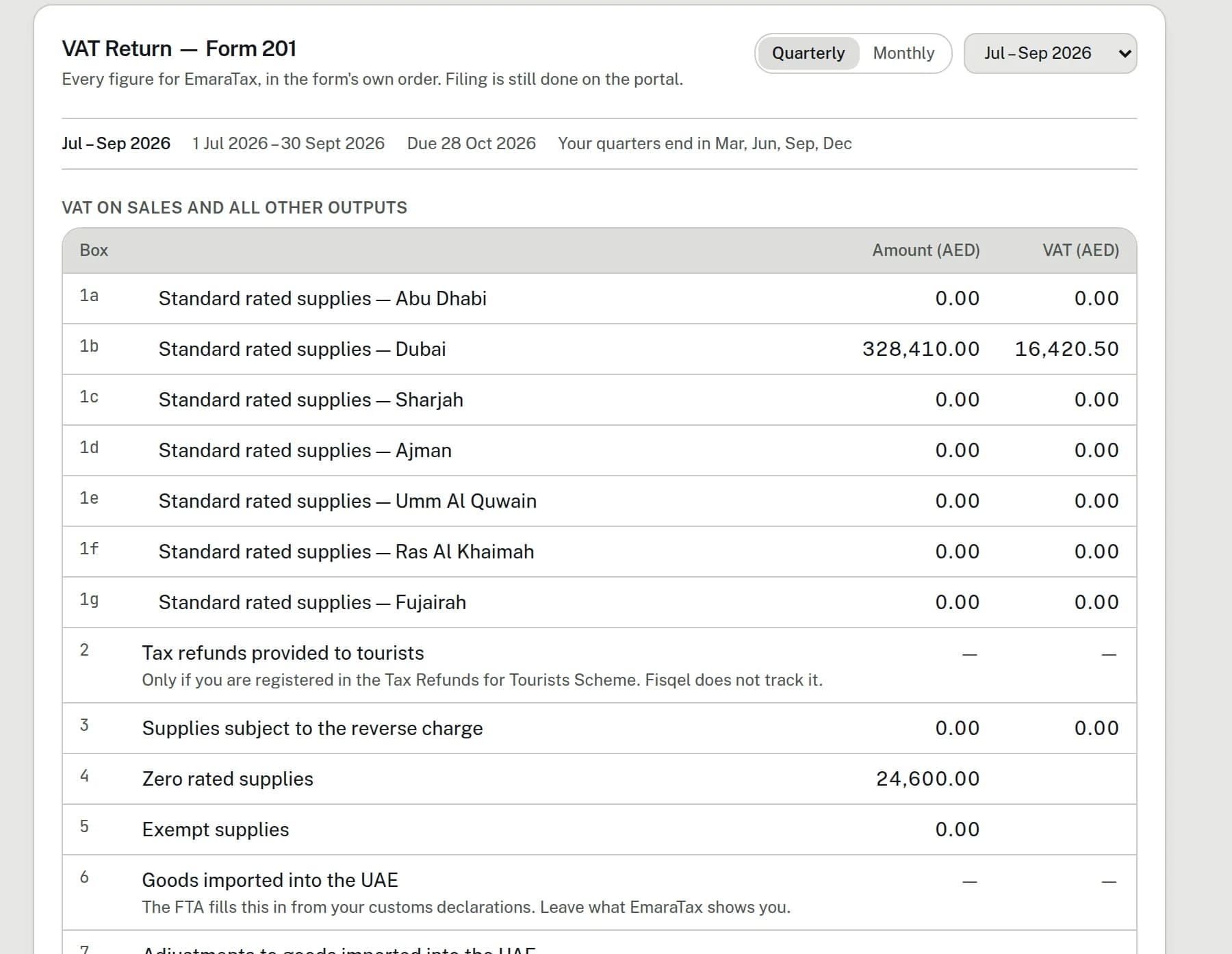
Real Fisqel screens, shown with a fictional sample business.
E-invoicing is coming
The UAE is moving to structured e-invoices exchanged through Accredited Service Providers (ASPs). Businesses will need to appoint an ASP before their phase begins.
Clean, structured, correctly classified records are the best preparation — which is exactly what Fisqel keeps.
1 July 2026
Pilot and voluntary adoption open.
30 October 2026
Businesses with revenue of AED 50 million or more appoint an ASP.
1 January 2027
E-invoicing mandatory for businesses at AED 50 million or more.
31 March 2027
All other businesses appoint an ASP.
1 July 2027
E-invoicing mandatory for all remaining in-scope businesses.
Questions
What owners ask first.
What's the difference between zero-rated and exempt?
Neither charges your customer VAT, but a zero-rated supply is still taxable: it goes on your return and you can recover the VAT on costs behind it. An exempt supply is outside VAT, and the input tax attached to it generally can't be recovered.
When do I have to register?
When your taxable supplies and imports have passed AED 375,000 in the last 12 months, or you expect them to in the next 30 days. You may register voluntarily from AED 187,500.
How often do I file?
The FTA assigns your tax period. Most small businesses file quarterly. The return and payment are due within 28 days of the period ending.
Does Fisqel file the return for me?
Fisqel prepares every figure for Form 201 in the form's own order. You, or your accountant, submit it on the FTA's EmaraTax portal and then record it as filed in Fisqel, which locks that period.
General information about UAE VAT, not tax advice. Rates, thresholds and deadlines are as published by the Federal Tax Authority and were last reviewed in September 2026. For your own situation, speak to a registered tax agent or your accountant.
Stop rebuilding your VAT return at the deadline.
Fisqel classifies every line as it happens, so the position you see today is the one you file.
14 days free · Cancel anytime · English and Arabic